
Hybrid Approaches
When no single structure fits, the right answer is often a blend.
Most ownership transitions are described as if you have to pick one path: an employee ownership trust, an ESOP, a management buyout, a family succession. In practice, the best answer often draws on more than one. A hybrid model simply means combining two or more of these structures into a single, coherent plan, shaped around your specific goals rather than a standard template.
That might look like a management team taking a direct stake through a buyout while the wider workforce shares in the business through an EOT. It might mean passing part of the company to the next generation while opening ownership to employees alongside them. Or it might mean starting with partial ownership today and phasing toward a fuller transition over time. The components vary; what stays constant is the aim: a transition that honours every priority that matters to you, not just the one that fits neatly into a box.
Your Life’s Work is in Good Hands
The Problem
Real businesses rarely fit neatly into one box. You might have a management team ready to lead, and a wider workforce you want to reward. A family member who wants part of the business, and a desire to share the rest more broadly. A wish to step back gradually rather than all at once. Faced with a menu of single structures, many owners feel their actual situation falls somewhere in between.
The good news: you do not have to choose just one. The challenge is designing a combination that balances competing goals, stakeholders, and timelines without becoming unwieldy, which is precisely the kind of design work we do.
Employee Ownership as a Solution
A hybrid approach combines two or more transition structures into a single, coherent plan. It lets you honour more than one priority at once: continuity for management, a stake for employees, a role for family, and an exit that works for you. Rather than forcing your goals to fit a structure, a hybrid shapes the structure around your goals.
What Is a Hybrid Approach?
A hybrid is a tailored combination of ownership and succession models. There is no fixed formula, but common blends include:
- An EOT paired with a management buyout, so leaders hold a direct stake while the wider team benefits through the trust
- A family transition combined with an EOT, sharing ownership between the next generation and employees
- An ESOP layered alongside a management buyout, broadening participation beyond the leadership group
- A phased plan that begins with partial ownership and moves toward a fuller transition over time
Why Choose a Hybrid: Key Benefits
The best of more than one model.
- Combines the strengths of EOTs, ESOPs, MBOs, and family succession
- Balances family, management, and the wider team in one plan
- Shaped to your timeline and vision, not a fixed template
Flexibility where it matters most.
- Lets you honour competing priorities rather than sacrificing one
- Can phase ownership in gradually, at a pace that suits you
- Designed to capture available tax and financing advantages across structures
How Does a Hybrid Work?
- We map your full picture. Your goals, your people, any family considerations, your timeline, and what success looks like to you.
- We identify the right components. Which structures, in what combination, best serve those priorities together.
- We design how they fit. Ensuring the pieces work as one coherent plan, with governance, financing, and tax considered across the whole.
- We implement and support. Bringing the combined structure to life, and staying with you as it takes hold.
Because a hybrid touches more than one structure, thoughtful design is everything. Done well, the complexity stays behind the scenes, and what you experience is a plan that simply fits.
Is a Hybrid Right for Your Business?
A hybrid approach tends to be a strong fit when:
- Your situation involves more than one stakeholder group, such as family and employees
- No single structure quite captures what you are trying to achieve
- You want to balance continuity, reward, and a workable exit at once
- You would value phasing the transition over time rather than all at once
If your needs and vision feel like they sit somewhere in the middle, a hybrid is very likely the answer. The best way to find the right combination is a conversation.
It’s Always the Right Time to Connect
Whether you are in the early stages of exploration or ready to start, let’s begin the conversation.
How We’ll Work Together – Your Step by Step
From Initial Conversation to Long-Term Stewardship
Discovery Call
We start with a no-obligation
conversation to understand
your business, your goals, and
your timeline. No jargon. No
pressure.
Structure Design
We assess your options —
EOT, ESOP, or MBO — and
recommend a structure
tailored to your values,
financial goals, and
employees.
Collaborative Planning
We stay with you through
closing and into governance —
offering ongoing coaching for
employee-owned companies
after the deal.
Transition & Beyond
We stay with you through
closing and into governance —
offering ongoing coaching for
employee-owned companies
after the deal.

Hybrid Approaches
Answers to Common Questions
Find quick responses to frequently asked questions and get the information you need in no time.
How Does Employee Ownership get funded?
There is no single model. In some cases, employees buy shares directly. In others, a trust or the company itself finances the purchase on their behalf. The structure depends on your goals, the financial capacity of the business and its employees, and how ownership is being transferred.
Some transitions involve employee contributions—others do not. What matters is designing a structure that fits your business and what is realistic for your team.
Is Employee Ownership only for large companies?
Not at all. Employee ownership can work for businesses of many sizes—from independent shops to professional firms. What matters more than size is having a strong team, steady cash flow, and an owner who wants to plan intentionally.
We typically work with companies ranging from 10 to 500 employees—helping them explore options that reflect their goals and capacity.
Why choose Employee Ownership over a third party sale?
A third-party sale often means handing your business over to an outside buyer—someone who may change leadership, restructure the team, or relocate operations. You may have less say in how the transition unfolds, or what happens to the people and culture you have built.
Employee ownership offers a different path. It keeps the business in trusted hands, supports continuity in leadership and operations, and can be structured to reflect your goals, timeline, and values—all while providing fair market value for the company.
What are the tax implications of selling to employees?
Each transition is unique. We work closely with your legal and financial advisors to ensure the sale is tax-effective and compliant. In many cases, employee ownership models can offer favorable tax outcomes for the exiting owner.
How long does the transition process take?
Timelines vary, but most employee ownership transitions take 6–24 months from planning to implementation. We tailor the process to your needs and guide you every step of the way.
Do I need to fully exit the business?
Not necessarily. With employee ownership, you can sell part or all of the company—and stay involved for as long as it makes sense. Some owners continue in their role for years, while others step back gradually or focus on mentoring the next generation. In some cases, employee ownership is used as a growth or retention strategy—not just a succession plan.
It is about designing a transition that fits your goals, your timeline, and the needs of the business.
Employee Ownership Models
Explore Other Options
Feeling like your needs and vision is somewhere in the middle? We also design hybrid approaches tailored to your goals, timeline, and team.
Employee Ownership Trusts — since 2024
EOTs
Canada’s newest and most powerful employee ownership structure, introduced in 2024. An EOT holds shares on behalf of employees — offering simplified governance, strong legacy protection, and potential capital gains tax advantages for the selling owner.
- Capital gains tax advantages
- Simplified governance model
- Long-term stewardship structure
Employee Share Ownership Plans
ESOPs
The most flexible ownership transition structure available to Canadian businesses. We design ESOP programs through share purchase plans, holding companies, or trusts — customized to
your goals, governance preferences, and
timeline.
- Broad-based employee participation
- Customizable vesting & governance
- Phased or full ownership transfer
Management Buyouts
MBOs
When the right successor is already inside the business, an MBO is often the cleanest path to continuity. We structure leadership-led transitions that work for both the departing owner and the incoming management team.
- Leadership continuity preserved
- Vendor financing structures
- Clean, confidential transition
Which Model is Right for Your Business? Let’s Find Out.
Whether you are in the early stages of exploration or ready to start, let’s begin the conversation.
Employee Ownership Course
Want to Learn More At Your Own Pace?
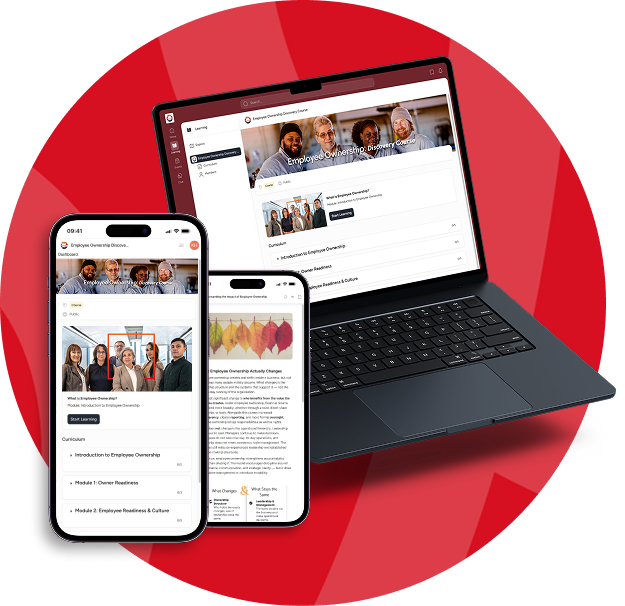
Our Employee Ownership Discovery course is a practical, self-paced introduction to employee ownership in Canada. It breaks down how employee ownership works in practice, the most common structures, and the financial and governance considerations that matter most—so you can explore the option with clarity and confidence, on your schedule.
Let’s Get This Transition Right
Partner with our dedicated team to turn your vision of employee ownership transition into reality.
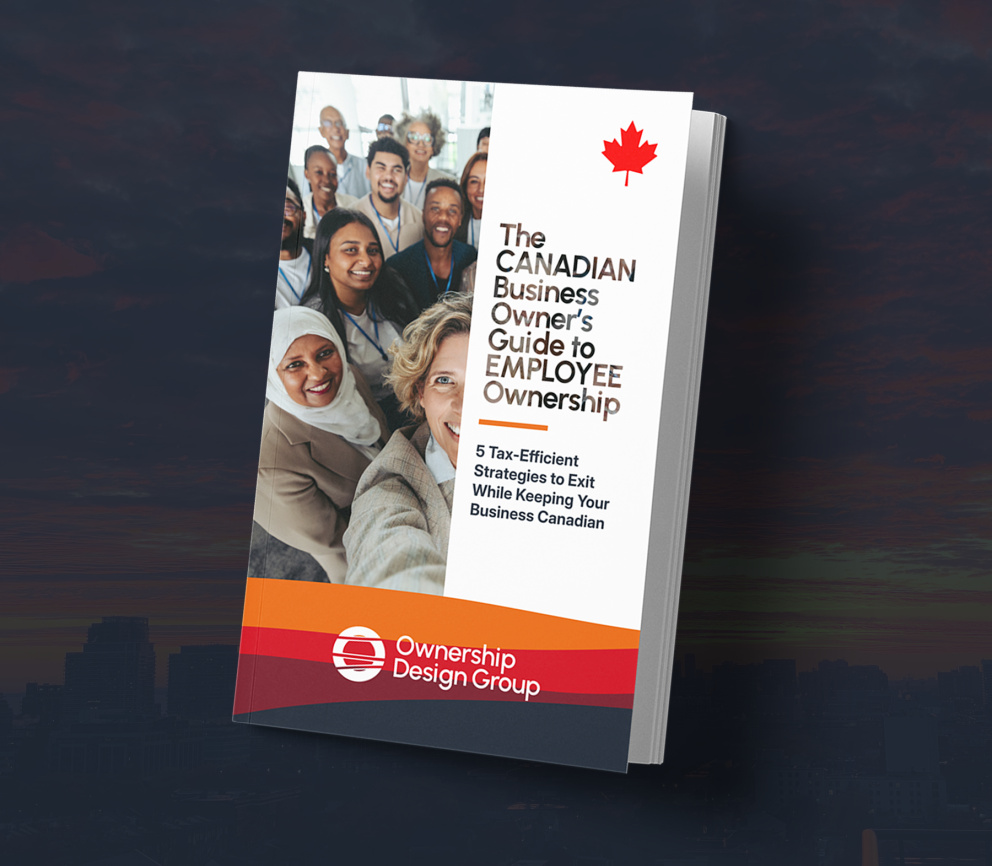
The Canadian Business Owner’s Guide to Employee Ownership - Digital Download
ACCESS YOUR DOWNLOAD HERE
Get Our FREE Canadian Guide Straight to Your Inbox.
Keep an eye on your inbox for your download access —you’ll also get subscribed to our newsletter with more insights and examples of how employee ownership is reshaping Canadian businesses.