
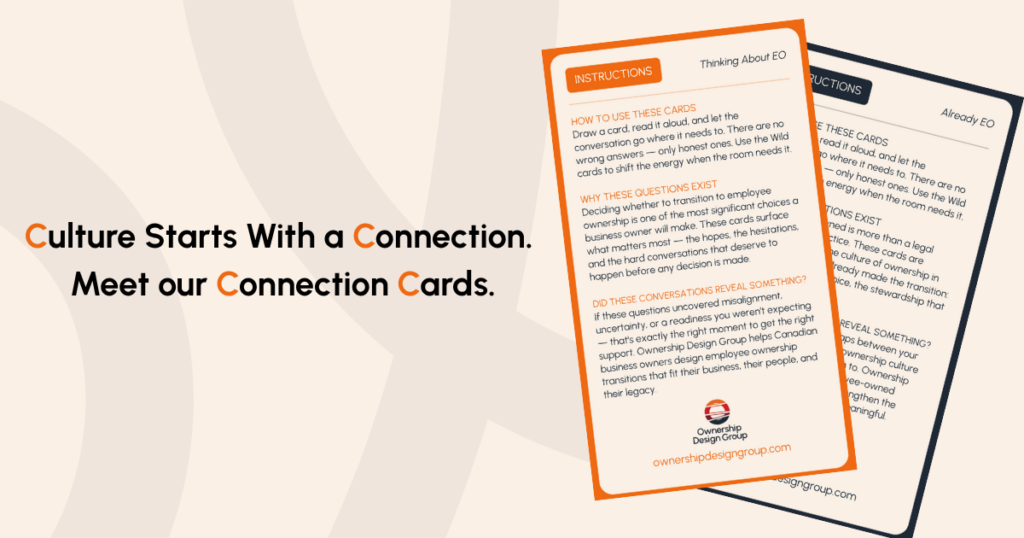
Most conversations about employee ownership begin with spreadsheets: valuation models, financing options, tax structures. These details are essential, and getting them wrong can sink a deal. But talk to enough leaders who have actually gone through a transition, and a different theme keeps surfacing as the true make-or-break factor — one that rarely shows up on a term sheet: culture. Good news: we built the tools specifically to help with that.
The paperwork changes fast. Mindsets do not.
Across a wide range of employee-owned companies, leaders consistently point to culture as one of the biggest drivers of whether a transition ultimately succeeds. The reason is not hard to understand: signing paperwork can make someone a shareholder overnight, but it does not rewire years of habit. Employees who have spent their careers executing someone else’s vision do not automatically start thinking, deciding, and taking initiative like owners the moment their name appears on a cap table.
This mirrors a much broader body of research on organizational change. Harvard’s John Kotter studied more than 100 companies attempting major transformations and found a striking pattern: the failures rarely came down to bad strategy. They came down to leadership underestimating the human side of change — skipping a clear vision, communicating poorly, or celebrating too early and letting momentum fade. An employee ownership transition is exposed to that exact vulnerability. The legal and financial pieces can close without a hitch while the cultural shift quietly stalls out behind the scenes.
What gets better when culture is treated seriously
When companies do the culture work well, the results show up in tangible ways. Ownership structures tend to dial down the internal rivalries that can quietly poison a workplace, such as competition over clients, credit, or commissions, and replace them with a shared stake in collective outcomes. That shift has measurable effects on retention: at least one fully employee-owned company has reported turnover running at less than half the typical rate for its industry, with employees crediting the ownership culture itself as the reason they have stayed.
Culture work starts long before the deal does
One of the most common mistakes is treating culture as a post-transition task, something to address once the structure is in place. In practice, the strongest transitions tend to start building trust, transparency, and shared purpose well before a decision to transition has even been made. Waiting until after closing to start the conversation means asking employees to trust a new system before they have had any chance to understand or shape it.
Tools built for exactly this conversation
This is the gap our connection cards were designed to close. Each of our two card sets contains over 100 discussion prompts meant to be used in a group setting: drawn one at a time, read aloud, and discussed openly. One set is built for teams and owners who are still deciding whether employee ownership is right for them; the other is built for companies that have already made the transition and want to keep strengthening the ownership mindset over time. No facilitator training is required, because the questions are designed to do the work themselves, whether you are using them in a two-person check-in or a full team session.
The goal is not to have all the answers upfront. It is to create a structured, low-pressure space where hard questions can surface honestly, so that by the time a transition happens, or as it continues to mature, everyone in the room actually understands what it means for them.
Curious which set fits where your organization is right now? Explore and shop our connection cards here.